On September 10, OpenAI's API changelog gained one line: "Released the Agents API in public beta. Build agents with a managed Codex harness while OpenAI handles session orchestration, context compaction, and recovery" (OpenAI API changelog, September 10, 2026). The launch post on OpenAI's developer forum added the part I read twice: "There are no additional fees for using the Agents API" (OpenAI community, September 10, 2026). You pay for tokens and tools. The loop itself costs nothing.
Three months earlier AWS had said the same thing about its own loop. The Bedrock AgentCore harness went generally available on June 17 with "no separate harness charge" (AWS docs; AWS What's New, June 17, 2026). And the Codex harness has been Apache-2.0 code on GitHub since April 2025 (initial commit with the license, April 16, 2025).
So the agent loop is a commodity. OpenAI and AWS both host theirs with no harness fee, and OpenAI publishes the source of its loop under Apache-2.0. What is left to choose is where the work runs, what is kept about it, and whether the result comes back with proof.
What "the harness" means here
A harness is the program around the model. It sends the prompt, reads the reply, runs the tool the model asked for, feeds the output back, trims the context when it gets long, and decides when the turn is over. Claude Code, Codex and OpenCode are harnesses. So is the loop inside AgentCore.
Until recently the harness was where many teams believed the advantage lived, and they had a reason. OpenAI's own developer blog reports that "retained reasoning and context compaction raised GPT-5.6 Sol's score from 13.3% to 38.3%" on ARC-AGI-3 "while reducing output tokens sixfold" (OpenAI developer blog, August 19, 2026). That is a vendor's claim about its own model on a benchmark it chose, and the change was two settings turned on, so read it as a direction rather than a measurement. The direction is clear: the same model, in a better loop, nearly tripled its score.
That is exactly why the pricing matters. The part that moved the number from 13.3% to 38.3% is the part now being handed out.
What the August post actually said
One correction to how this has been retold. The August 19 post, "Codex as a platform: build on the open agent harness", describes components that were already public, open source for months: "We publish the Codex CLI, app-server, and official Codex SDK as open-source components." The repository's Apache-2.0 license arrived with its initial commit on April 16, 2025, the TypeScript SDK with a scaffold on September 29, 2025, and the app-server became its own command on September 30, 2025.
The news in August was the framing. OpenAI told developers to build products on its loop, and drew a line around what stays closed: "The open-source layer is the harness and integration surface; model access and managed services remain separate." Three weeks later the managed service arrived, and it charges for the model and the tools, never for the loop.
When a vendor publishes the source of a thing and then hosts it for free, the vendor is telling you where it expects to make money. Here that is the model and the compute.
What each vendor gives away, and what it keeps
Put the three offers side by side and the open questions sit in the same rows for all of them.
Where it runs. OpenAI lets you "bring your own sandbox or connect a sandbox provider," lists nine sandbox providers by name, and introduced its own hosted sandboxes in the same launch (OpenAI community, September 10, 2026). AWS gives every session "its own dedicated microVM with isolated compute, memory, and filesystem resources," terminated and sanitized when the session ends, with a default maximum lifetime of 8 hours and a 15-minute idle timeout (AWS runtime sessions docs). AWS bills that compute per second, at $0.0895 per vCPU-hour and $0.00945 per GB-hour of actual consumption (AWS Machine Learning blog, June 18, 2026). The harness is free; the machine it runs on is where the meter starts.
What is kept. OpenAI's documentation says the Agents API "retains session state so you can continue work across turns," and that it "currently supports data residency only in the United States and does not support Zero Data Retention (ZDR). Choosing a self-hosted sandbox does not make the Agents API ZDR-eligible" (OpenAI docs, quoted by StackOne on September 14, 2026). That last sentence is the important one. You can move the computer into your own network and the record of the work still sits with the vendor. For a team whose agents read customer data, that settles the choice before price comes up.
Proof. The Agents API launch lists what an agent can do: run code, work with files and produce artifacts you download later (OpenAI community, September 10, 2026). An artifact shows what the agent made. It does not tell you whether the pull request passes its checks, whether the report answers the question that was asked, or whether the agent quietly gave up halfway and wrote a confident summary. None of the three offers decides that for you.
Why proof is the row that matters
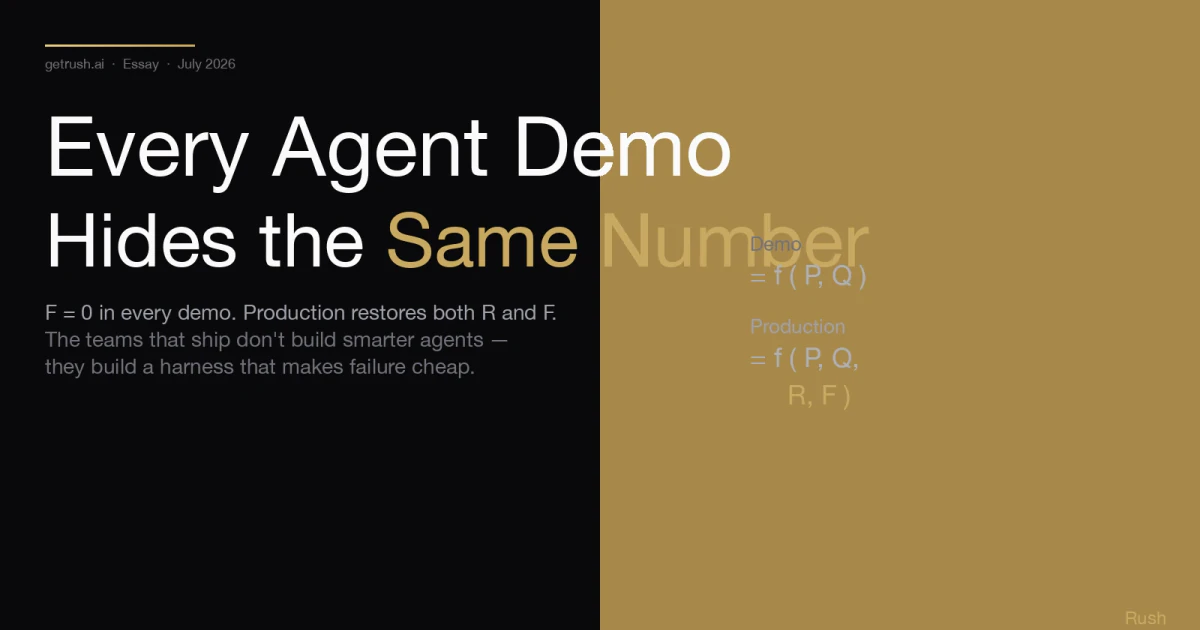
I wrote in July that every agent demo hides the cost of failure. A free loop makes that number more important. When anyone can start an agent for the price of its tokens, the expensive event is an agent reporting success on work that did not succeed, and a person finding out three days later.
A result with proof has two parts. The first is the evidence, which for code is a pull request with its checks run, and for other work is the file, the report or the answer, with the full trajectory of what the agent read and ran beside it. The second is the refusal: when that evidence is missing, the run says so in its status instead of saying "done."
Neither part lives in the loop. The loop knows when the model stopped talking. Only something outside it knows what the request asked for and can compare the two. That is also where the record belongs, since the record is the thing you will need when you go looking for an agent's work a month from now, and the thing that makes your agents yours instead of everyone's once everyone rents the same model and the same loop.
The honest limits
Three caveats. The ARC-AGI-3 figure is OpenAI measuring OpenAI, and I would not plan around the size of the jump. "No harness fee" is a pricing choice, and pricing choices change; a public beta can add a line item the day it leaves beta. And Rush benefits from this trend, which you should weigh when you read my conclusion: we run these same harnesses, so every vendor that makes the loop better and cheaper makes our runs better and cheaper too. We also rent our microVMs from a provider. Owning compute was never the point for us.
What we do with it
Rush takes the loop as given and works on the other three rows. A caller sends a request; the agent, today Claude Code, Codex or OpenCode run exactly as it runs in a terminal, does the work in its own cloud sandbox, one microVM per task, with a computer and a browser, and the trajectory of what it read and ran is captured. Today proof is live on one path: an ephemeral run that pushes code comes back as one pull request with its checks and the trajectory beside it, and a run that cannot show that ends as needs_review. Other work comes back as the report, files or answer with the same captured trajectory; checking that kind of output against the request is still ahead of us.
Where the money moves
When a layer of the stack becomes free, the work moves to the layers next to it. Compilers became free and the value went to what people compiled and where they deployed it. Operating systems became free and it went to the clouds that ran them.
The agent loop crossed that line this summer, with an Apache-2.0 license on one side and, on the other, two vendor pages that say there is no additional or separate harness fee (OpenAI community, September 10, 2026; AWS docs). The questions a buyer asks next are the ones the loop cannot answer: which machine ran this, who can read what it saw, and how I know it finished. Those are the questions worth building for now.