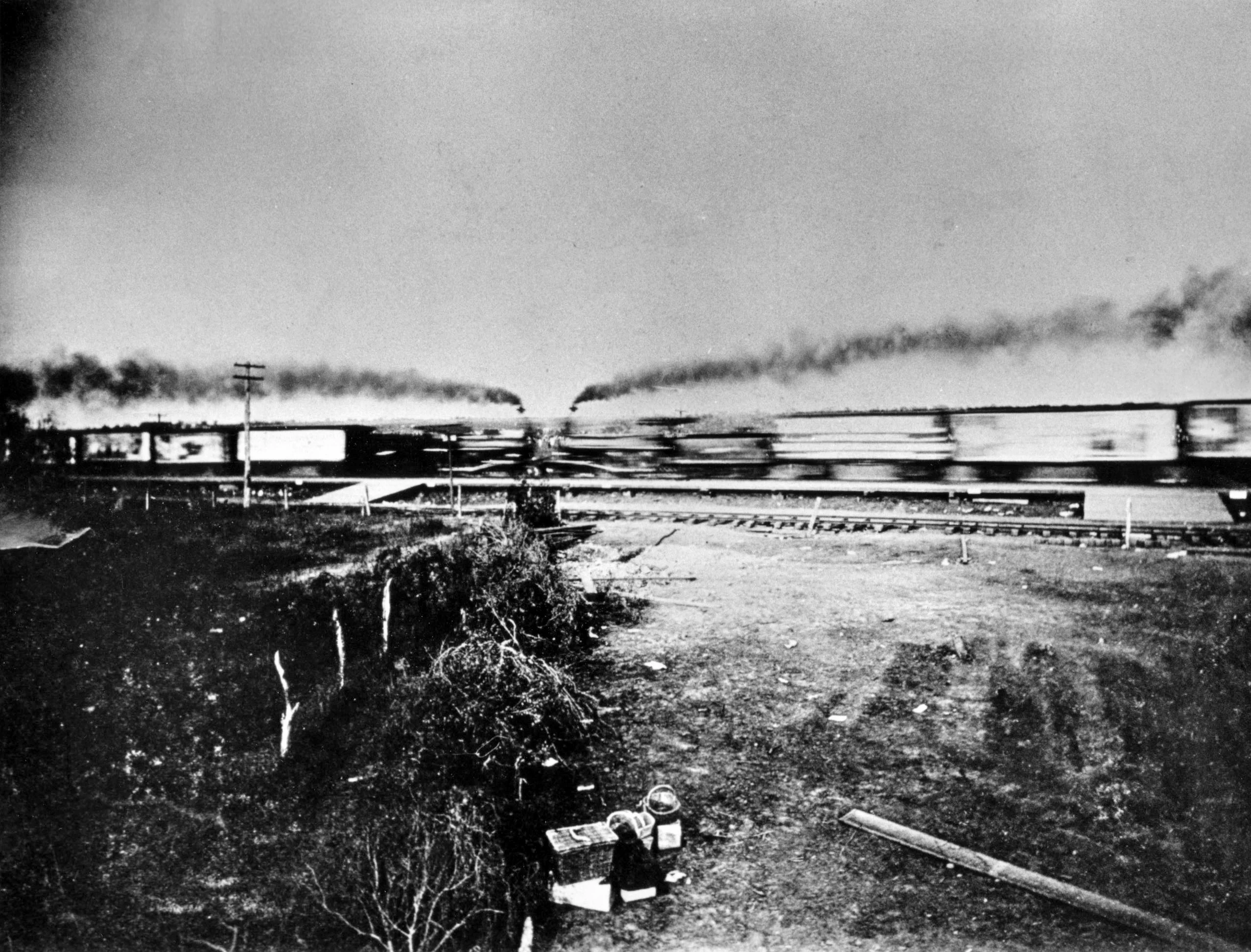
On the fifth of October, 1841, two Western Railroad trains ran head-on into each other between Worcester and Albany. They collided for a plain reason: they had no way to talk. Trains ran on a printed timetable and nothing else. One was behind schedule, the other guessed it could reach the passing point first, and they met on a blind curve. A conductor and a passenger died, and seventeen people were hurt. It was one of the first times an organization killed its own customers purely through miscommunication.
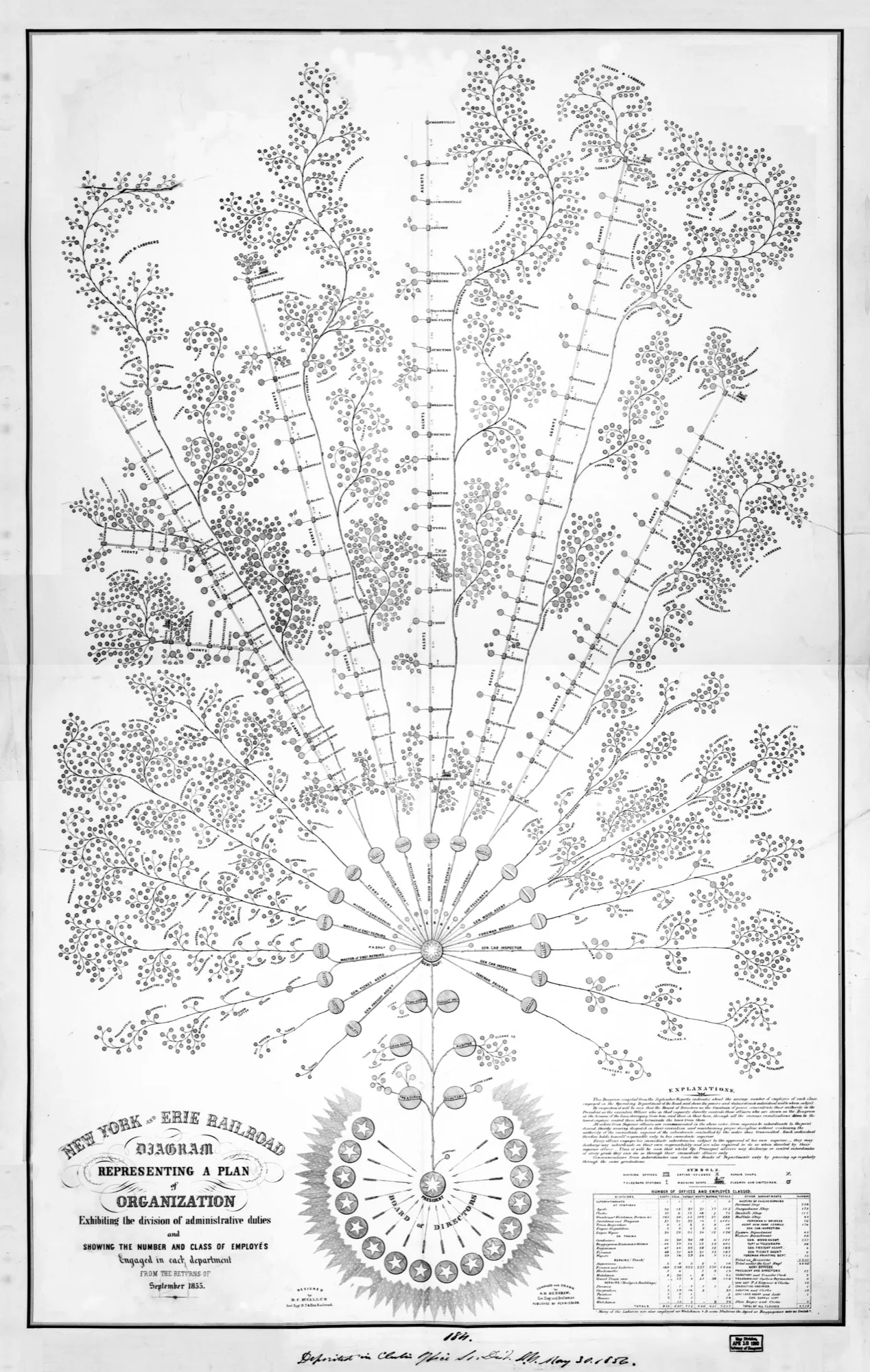
The railroad was the first thing humans built that was too large and too fast to run by talking. The fix, when it came, was not a better train. In 1855 a superintendent named Daniel McCallum drew a diagram of the New York and Erie Railroad: who reported to whom, who decided what, where information flowed. It is remembered as the first modern org chart. His real insight was not the boxes. It was that the men down the line held the best operating data, so he pushed authority down to them and built the chart to move information, not just orders. Alfred Chandler later called this the birth of management itself.
A few months ago I wrote that agents are eating the org chart. Once a company can make its judgment loops executable, the boxes stop being people and become running processes. That was the whole argument. What I did not say is what happens next, because what happens next is that the railroad crashes again.
The scale nobody priced in
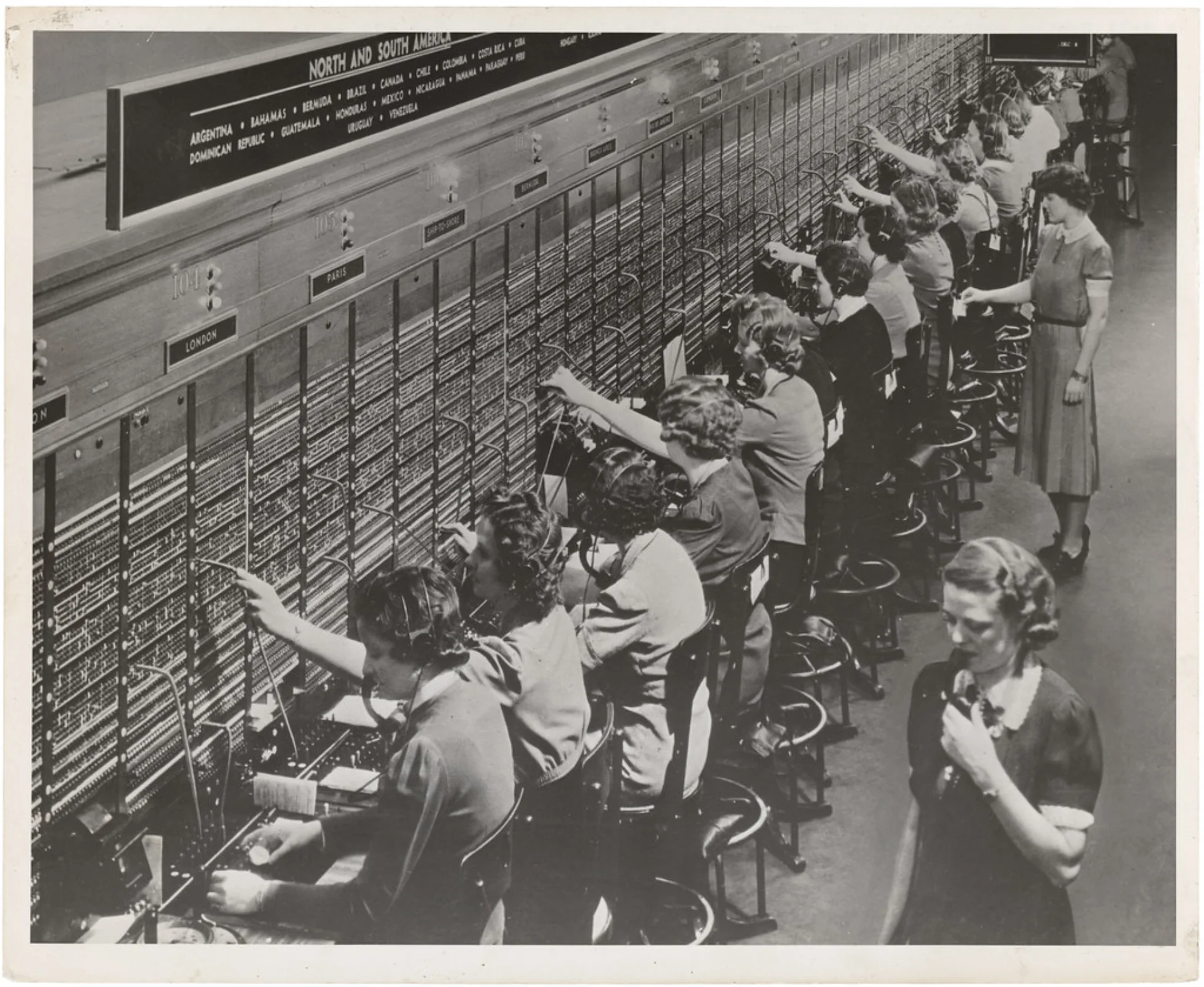
Here is the scale nobody has priced in. Take a firm with ten thousand employees. Give each of them a hundred agents, then a thousand, then ten thousand, running all day. The firm has quietly become a ten-million-worker organization, and every one of those workers acts in milliseconds. You did not grow your headcount by a factor of ten. You grew it by a thousand, and you sped it up by a thousand more. Nothing in the history of organizations has moved that fast at that size.
At human scale, coordination is a tax you can pay. At this scale it is the whole game. When ten million fast workers act on stale or conflicting context, they do not just waste effort, they work against each other, and the damage shows up faster than any manager can see it. This is the 1841 collision, except there are ten million trains and the timetable changes every second.
This is not a forecast. Boris Cherny, who built Claude Code, says that on some days he manages tens of thousands of agents at once. Jensen Huang tells rooms that Nvidia's 75,000 employees will soon work with 7.5 million agents. Notion runs a thousand people beside more than seven hundred agents and calls where this goes "building Tokyos." The ten-million-worker firm is not a thought experiment. It is a Tuesday.
Two forces, pointing opposite ways
A firm in the agent era is pulled by two forces that point in opposite directions. One makes it unstoppable. The other tears it apart.
The first force is compounding. A firm is not a state, it is a trajectory. Every run leaves something behind: a lesson, a correction, a scar. Fold those back into how the firm works and its judgment sharpens, its products improve, and it slowly becomes specialized in a way no competitor can copy. This is not a hunch. In 1936 Theodore Wright measured airplane factories and found that every time cumulative production doubled, the labor to build the next aircraft fell about twenty percent. The same twenty percent per doubling later showed up in semiconductors, and as Swanson's Law in solar. Plot it on log paper and it is a straight line across a century and three industries. Learning compounds, and it compounds lawfully.
The coordination wall
The second force is coordination, and it is the one that kills you. Put a number on it. In a group of N workers, the ways they can talk past each other grow with the pairs between them, which is close to N times N. Fred Brooks named this in 1975: adding people to a late project makes it later, because every new person adds a line to everyone else. Ten people is forty-five pairs. Ten thousand agents is about fifty million. Ten million agents is about fifty trillion. Nothing coordinates fifty trillion conversations. No hierarchy, no meeting, no manager survives that number.
There is one way out, and it is old. Stop making everyone talk to everyone. Give them one shared thing to read and write, and let each one sync with that instead of with each other. Now the lines do not run between the workers, they run to the memory, and N times N collapses to N. That single move is the whole difference between an organization that scales and one that shakes itself to pieces.
You have lived a small version of this. A remote team on Slack moves faster than one on email, and not because Slack is prettier. Email is a private paper trail, one thread between two people, and it piles up into the same hairball. Slack is a shared, searchable room the whole team reads. Email is perfect for the contract you sign once a month, and miserable for coordinating a team every day. Slack won because it turned N times N back into N. Agents just raised N by ten thousand, and the same rule decides who lives.
Now the two forces click together. The thing that compounds your learning and the thing that tames your coordination are the same thing: a memory the firm owns and shares. Keep your scars in it and you compound. Let every agent read and write it instead of messaging each other and you cohere. One asset, both jobs. Rent it or leak it and you lose both at once, and the N times N tears you apart.
The model is the steel. Your memory is the core.
The smartest people in this conversation have each seen one face of it. Ivan Zhao of Notion put it best: AI is steel for organizations. Before steel, a building could not pass six floors, because stone and iron collapse under their own weight. A growing company collapses the same way, under the weight of keeping everyone aligned, and Zhao is right that the model is the steel that lets you build taller.
But steel is a commodity. Everyone can buy the same steel, the same way everyone can rent the same model. A skyscraper does not stand because of its steel. It stands because of its core: the central spine every floor plugs into. One floor connects to the core, not to all the other floors, and that is why a tower can rise a hundred stories without twisting apart in the wind.
The model is the steel. Your memory is the core.
That is the piece the room is missing. Jack Dorsey and Roelof Botha argued for replacing the hierarchy with a "world model," the intelligence living in the system and the people on the edge. The memory crowd says that when everyone holds the same models, memory is the only moat left. Each has a hand on one face of the same object. Set them together and it has a name: the shared, owned memory is the core of the agentic firm, and it does two jobs nobody has joined.
It coheres. Every agent plugs into the one core instead of into every other agent, and the N times N that would shake the firm apart collapses back to N.
It compounds. Unlike real steel, this core gets stronger every day the building is occupied. Every run writes a lesson back into it, and by Wright's law the whole structure gets better and cheaper as it rises. The coordination fix and the moat are not two things you build. They are one thing, and it is a memory you own.
So rent the mind, rent the muscle, and own the memory, because the memory is the only part that is yours and the only part that compounds. Everyone rents the same model. You cannot out-model your rivals. You can only out-remember them.
The successor to the org chart
The railroad's answer to its crash was the org chart, the telegraph, and in 1883 standard time, which put every station in the country on one clock so trains would stop meeting on blind curves. Notice the pattern. The fix was never a stronger locomotive. It was a shared, common picture that every part of the system could act on, plus McCallum's move of pushing authority down to wherever the data actually lived.
That pattern has a name in every era that hit this wall. The Prussian General Staff called it mission command: a shared doctrine so units moved as one without waiting for orders. Toyota called it kanban: a shared signal on the line. On the internet it was Slack, a shared room that let teams outrun the ones still trapped in email. Amazon called it the API mandate: every team forced to speak through one contract. Each time an organization outran human-speed communication, it survived by giving every part the same picture and letting it act locally.
The agent era just made outrunning human-speed communication the normal condition, and it made the shared picture a memory instead of a meeting. The org chart moved orders down a hierarchy. Its successor moves context across a mesh: every agent reads from the same owned memory, acts where it stands, and writes back what it learned, and the whole thing stays coherent without a manager in the loop, because the coherence lives in the memory, not the reporting line. The org chart was the last genuinely new unit of organizational design, and it held for a century and a half. Its successor is not a flatter chart. It is a core.
This is where it stops being an argument and starts being a picture. A firm that owns its shared memory can run a thousand experiments at once, read its own results honestly because the evals live in that memory, kill what failed, and pour everything into what worked, faster than a competitor can schedule the meeting. It compounds because it keeps its scars, and it coheres because every part is reading the same page. It stops behaving like an org chart and starts behaving like an organism: ten million moving parts, one nervous system, getting sharper and more in sync with every step.
The railroad taught us that scale and speed kill an organization that cannot get on the same page, and the ones that could not keep up died. Agents just raised both by ten thousand. The winners will not be the ones with the most agents or the best model, because those are rented and everyone has them. They will be the ones whose memory both compounds their judgment and holds their millions together at once. Compound and cohere, on a memory you own. That is the whole game now.