Blog
Notes from building Rush
Engineering, research and launches from the team at Rush, and what we learn from agents doing real work in the cloud.

Give Your Agent a Phone
Rush now connects LumisReach, so an agent running on Rush can place a phone call or hold a text conversation, then read back the transcript, summary and recording.
Read essay →
When an Agent Makes a Mistake Twice, We Make It a Check
Two of us merged 11,040 pull requests in a year, most written by agents, with no specs or proofs. How the code stayed clean, and 32 times we overrode our reviewer.
Read →
Your Agent Can Use Any App. For a Quarter Fewer Tokens.
computer-cli, the computer-use tool your agent calls, used 26% fewer input tokens than Cua's MCP server on 20 hard OSWorld tasks, at the same pass rate.
Read →
Agents Now Write Their Own Instructions. Who Reviews Them?
Agents now keep memory, write their own skills and write the workflows that run other agents. Each of those files changes production, so treat it like code.
Read →
Our Writing Agent Made 858 Commits. Then It Died Quietly.
An unattended agent committed every half hour for 45 days. Then its config vanished and the scheduler ran empty for 64 days, and no alarm went off.
Read →
The Interrupt Is the Interface
A running coding agent changes the job. The control that matters is the record that lets you stop, steer, and inspect a run and keep the work.
Read →
Turn Every Repeated Review Comment Into a Failing Test
A style guide is read once; a check fails at the moment of the mistake. A 49-line test took our API from 82 test files mocking our own code to zero in 22 days.
Read →
Meta Gave Every Consumer a Cloud Computer
Meta Muse runs each user's agent on its own cloud computer, with a second agent approving what leaves and a full record. Consumers got this before most companies.
Read →
The Model Learned CAD. The Spool Still Jammed.
GPT-6 Astra rebuilds parts as CAD code at 95.9% voxel overlap. When our agent printed a part, the CAD was one step of ten, and the checks decided the result.
Read →
We Deleted 862,973 Lines in Nine Days
From September 6 to 15 we removed 3.3 lines for every line we added. Agents bias toward adding, so we made deletion the default and made new code argue for itself.
Read →
The Harness Is Free Now
OpenAI hosts the Codex harness behind an API at no added fee, and AWS runs a managed agent loop. Left to choose: where work runs, what is kept, and the proof.
Read →
The Agent Turned Off Its Own Sandbox
A confined agent in DeepSeek Harness called its own local control API and switched its session to full access. Isolation the agent can reach, it can undo.
Read →
When You Can't Read the Model's Thoughts, Read Its Actions
GPT-6 Astra writes less of its reasoning down and OpenAI says it is harder to monitor. Oversight moves to what the agent does, and that record is infrastructure.
Read →
Never Let the Author Grade Its Own Work
When every agent pushes as one GitHub identity, an agent approving its own pull request looks like a review. A reviewer on another model, and a record, can tell.
Read →
Your Harness Already Has an Eval Set. It's the Transcripts.
In 30 days our agents started 227 browser tasks, closed 92 and wrote one workaround 1,376 times. Mining our own transcripts found it, with no synthetic benchmark.
Read →
Done Means Installed and Demonstrated
Our terminal crash fix merged and shipped, and sessions still died on the installed build. The finish line is the installed artifact doing the thing, with a capture.
Read →
Instructions Are Read Once. Hooks Fire at the Mistake.
Our rules file told agents in capitals never to build Go binaries by hand, and they kept doing it. A hook that blocks the action and names the next step held.
Read →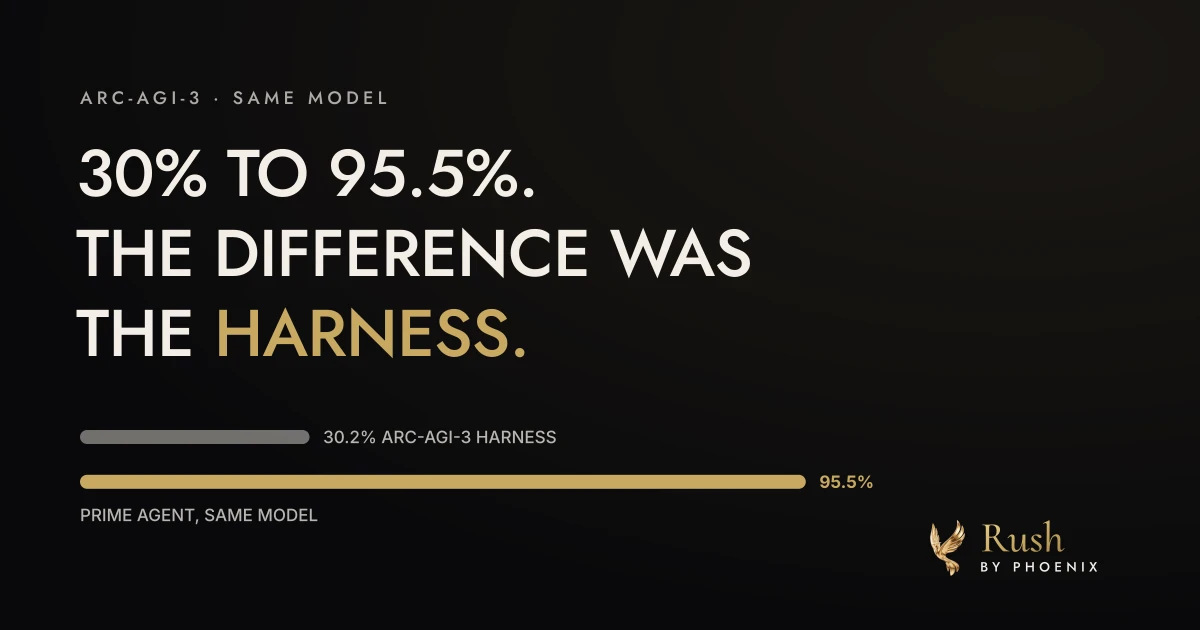
One Model, 30.2% and 95.5%. The Harness Was the Difference.
Prime Intellect moved Claude Opus 5 from 30.2% to 95.5% on ARC-AGI-3 by changing what wraps it. If the gain lives in the harness, the run history is the asset.
Read →
Sixteen Hours at 50%, Three Hours at 80%
METR measured an agent that finishes sixteen-hour tasks half the time and three-hour tasks four times in five. Checks, retries and proof cover the distance between.
Read →
An Agent You Can't Find Is an Agent You Don't Have
Run more than a handful of agents and the hard engineering stops being intelligence. It becomes addressing: identity, index and resume. The model is rented.
Read →
Your Sandbox Is Only as Isolated as Its Package Proxy
OpenAI's evaluation agents reached Hugging Face production through a package registry cache, the one service their sandbox could use. Isolation covers every channel.
Read →
The Fastest Browser Agent Isn't the Cheapest to Run
Vercel's agent-browser returns a warm snapshot in 56ms. On a byte-identical page it beat the browser Rush agents drive on latency; ours used 5.8 times fewer tokens.
Read →
The Other Way to Speed Up a Browser Agent
A HAR trick turns a browser task into a typed client, 30 seconds down to 200ms, if the API is stable. The other half: a fast live browser loop, 632ms to 3ms.
Read →
After the Org Chart
The model is the steel; your memory is the core. In the agent era everyone rents the same mind, so you cannot out-model your rivals, only out-remember them.
Read →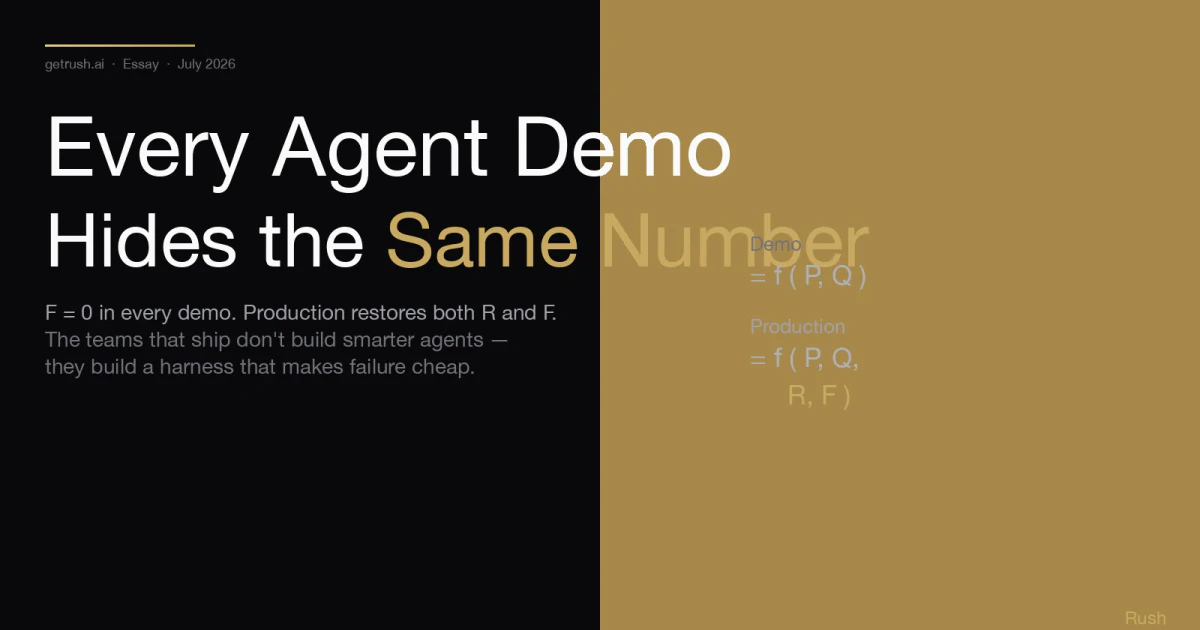
Every Agent Demo Hides the Same Number
A demo sets the cost of failure to zero and skips independent review. Production restores both. That delta — not the model — is what kills 88% of agent pilots.
Read →
Sovereignty Lives in Your Agents' Trajectories
Sovereign AI argues about weights. For a company running agents, the asset is the record of every run, and whoever stores it holds the alpha.
Read →
Loop Engineering Needs Somewhere for the Loops to Run
When people stop prompting agents and write loops, the loop is infrastructure: a machine off your laptop, isolation per run, a wake-up and a record of each pass.
Read →
The Three-Bet Era
Marc Andreessen said software is eating the world, and for fifteen years he was right. The cognition era asks one company for three bets, and wrappers will find out.
Read →
Agents Are Eating the Org Chart
AI did not just automate coding. It made organizational judgment loops executable. Software factories are the prototype for a class of programmable institutions.
Read →